The Apothecary
Our first honest product: an early-harvest olive oil from a single Greek estate.
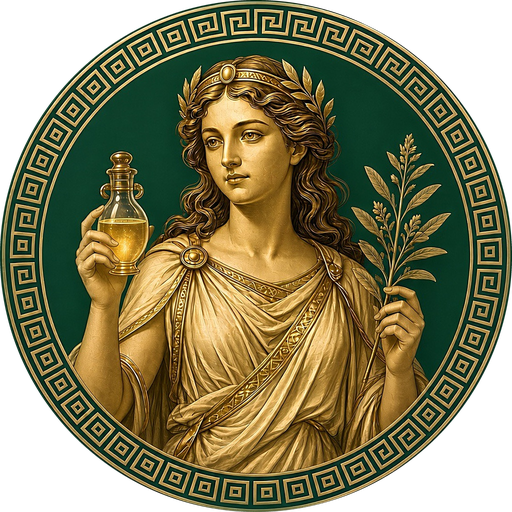
The Oil of Gods
Cold-pressed extra virgin olive oil: what it is, what Europe allows us to say about it, and what the research has really found.
A very old story
Long before anyone wrote a word about vitamins or fatty acids, the people of ancient Greece were pressing olives.
To the Greeks, the olive was the gift of Athena, goddess of wisdom, and her olive trees were sacred. At the Panathenaic Games, held in Athens in her honour, the champions were not given gold. They were given olive oil: great painted jars of it, pressed from Athena’s own sacred trees.
Three thousand years later, olive oil is still at the heart of the Mediterranean way of eating, and it has become one of the most closely studied foods in the world.
What “cold-pressed” means
Extra virgin olive oil is simply the juice of fresh olives. The fruit is crushed into a paste and the oil is separated by mechanical means alone: no solvents, no chemical refining.
European law sets the standard. Only oil made below 27°C may be labelled “cold extraction” or “first cold pressing”, and to be called extra virgin it must pass both a laboratory test (free acidity no higher than 0.8%) and a tasting by a trained panel, which must find no defects at all.
Keeping the oil cool protects its flavour and the natural compounds that give good olive oil its grassy, bitter, peppery character. Refined oils lose most of them.
At a glance
- Good for your heartReplacing saturated fats in the diet with unsaturated fats contributes to the maintenance of normal blood cholesterol levels. Oleic acid is an unsaturated fat.Panacea Olive Oil is high in unsaturated fat, chiefly oleic acid.
- Helps protect your blood fatsOlive oil polyphenols contribute to the protection of blood lipids from oxidative stress.Panacea Olive Oil contains at least 5 mg of hydroxytyrosol and its derivatives per 20 g. The beneficial effect is obtained with a daily intake of 20 g of olive oil (about 1½ tablespoons).
- Helps protect your cellsVitamin E contributes to the protection of cells from oxidative stress.Panacea Olive Oil is a source of vitamin E.
These are official health claims, approved in the UK and the European Union only after the science has been reviewed. Enjoy Panacea Olive Oil as part of a varied, balanced diet and a healthy lifestyle.
What’s in the bottle
Why polyphenols matter
Polyphenols are natural plant compounds, and good extra virgin olive oil is full of them: hydroxytyrosol, tyrosol, oleuropein and oleocanthal. You can taste them. They give fresh oil its bitterness and its peppery bite, and that little catch at the back of the throat comes from oleocanthal. Professional tasters treat it as a sign of a fresh, high-quality oil.
They are also natural antioxidants, so they protect the oil itself, slowing the rate at which it goes stale and helping it keep its flavour for longer.
Most importantly, they are behind one of the approved health claims: olive oil polyphenols contribute to the protection of blood lipids from oxidative stress. That claim can only be made for oils with at least 5 mg of hydroxytyrosol and its derivatives per 20 g, and Panacea Olive Oil meets it. The beneficial effect is obtained with a daily intake of 20 g of olive oil.
You will often see olive oils sold on their polyphenol count, measured in milligrams per kilo. The approved claim’s level of 5 mg per 20 g works out at around 250 mg/kg, and that is the level the science behind the claim was able to stand behind. Some oils are now marketed at 1,000, 1,500 or even 2,000 mg/kg, at prices to match.
And in keeping with the spirit of Panacea: more is not always better. There is no good evidence that an oil with a far higher count does any more for you, and every oil above the line carries exactly the same approved claim. The very highest counts mostly make an oil more fiercely bitter, and an oil too harsh to enjoy tends to sit in the cupboard.
What matters is simpler: an oil comfortably above the line, fresh from a recent harvest, properly tested, and pleasant enough to use every day. That is what we look for in Panacea Olive Oil.
What the research has found
PREDIMED, Spain
A large trial followed 7,447 adults at high risk of heart disease. People asked to follow a Mediterranean diet with extra virgin olive oil had around 30% fewer heart attacks, strokes and cardiovascular deaths than those advised to follow a low-fat diet.
The trial was republished in 2018 after problems were found with how some participants were assigned to groups; the results held up when they were removed. It tested a whole way of eating, not olive oil on its own.
Harvard, 28 years, 92,000 people
Among US health professionals followed for almost three decades, those who had more than half a tablespoon of olive oil a day had a 19% lower risk of dying from cardiovascular disease than those who rarely or never used it.
This is an observational study: it shows a link, not cause and effect. People who used more olive oil also tended to smoke less, exercise more and eat more fruit and vegetables.
The honest bottom line
Olive oil is not a panacea. Nothing is. But as a replacement for butter and other saturated fats, as part of a varied, balanced diet, it is one of the best-studied and most enjoyable foods there is.
That is why we chose it. Not because it cures anything, but because it is good food with good evidence behind it.
Free guide: How to Spot a Fake Extra Virgin Olive Oil
Six simple checks so you’re never fooled again.
Join the waiting list and it’s yours.
We’ll only use your email to send you Panacea news. No spam, and you can unsubscribe at any time.
This page is for general information only and is not medical advice. A varied and balanced diet and a healthy lifestyle are important. If you have a health condition, please speak to a qualified health professional.